| |
_______________
1 [Back to Text] Even though this evidence is available on the Internet
and in facsimile reprints (exact copies of 1611 Bible editions), some
'preachers' still refuse to recant their erroneous view of this passage.
Instead, they revert to arguments that require an impossible stretch
in basic English grammar: They complain this marginal note is attached to only one "them"
in verse 7 ("preserve them"); not both.
I trust that God "keeps [His words]" too; as should any Believer
who reads Isaiah 40:8 ("But the word of our God stands forever.")
and many of the verses in Psalm 119; expressing the same thought.
However, there's only one way those 'preachers' can still cling to the view this
passage somehow has anything to do with a particular translation of the Bible:
They must twist the straightforward understanding of this verse by
attempting to force the last phrase, "from this generation for ever"
to connect with "Thou shalt keep them" (though it says nothing about
translated words at all), without ever explaining why the Spirit would
confusingly (if they were correct) bring up a completely different subject in
an intervening phrase before finishing a short thought that grammatically
cries out for there to be nothing in between! We could also add that later
corrected editions (such as Blayney's 1769 edition; often considered
to be the real KJV Bible by so many), do not have a comma after
the second "them"; showing that all later editors understood
"preserve them" as obviously being connected to what follows
("from this generation for ever").
Some Insight into the Hebrew Text from the King's Translators
So what's the basis for the King's Translators noting
the word they translated as "them" was actually "him"
in the Hebrew text? If you open any Hebrew Interlinear Bible, you'll eventually
discover that word ("him") is only part of a single Hebrew
word they translated as "thou shalt preserve them"; which comes from
the verb to keep, guard against danger or preserve (Strong's
#05341 root: natsar). In the Hebrew text, that word
(represented here by English characters) is: teets-rennu ,
and it's the "nu" at the end (a suffix) that tells
us "preserve" must be related to a '3rd person masculine
singular' object identified by the Translators as him (even though
they translated it as "them"). But what about the first
"them" in this verse? Well, that word is part of the verb
shamar (Strong's #08104; a synonym of
natsar); which is written in the Hebrew text as teesh-meh-raim,
and translated as "Thou shalt keep them." It's suffix "aim"
means that the verb takes a '3rd person masculine plural'
as its object. Now think: What is the only difference between these two
verbs concerning their suffixes? Let's continue. What you now have here
is a good idea why the King's Translators decided to translate
the object of the second verb ("preserve") in the plural
(changing him to —> them) just as they did for the first
verb ("keep"):
It's because they knew both of these verbs must refer to a masculine
object; for which there's really only one choice in this section of Scripture!
Before we continue, you need to know that because a Hebrew verb is what
we call grammatically masculine, that does not necessarily mean it
must refer to a male; it does, however, mean it must refer to a masculine
noun, pronoun or adjective. Verse 6 has two occurrences of the noun
"words" (Strong's #0565, root: ’imrah
or ’emrah meaning an utterance, speech or word);
though the words are written slightly different in the Hebrew text (the first is:
’ee-ma-roth and the second: ’a-mah-roth)
what matters in our discussion here is the fact both are 'feminine plural
nouns.' Therefore, it's impossible for the verbs in verse 7
(which must have masculine objects) to refer to the two "words"
in verse 6 (which are both grammatically feminine).
So, what's left in this passage for the verbs to refer to, which also 'makes sense'
grammatically? Well, both the "poor" (Strong's #06041
‘aniy — poor, afflicted, humble) and its synonym, the "needy"
(Strong's #00034 ’ebyown — in want, needy, poor, abused) in verse
5 are either a 'masculine plural adjective' ("poor") or a
'masculine plural noun' ("needy"). So there's no problem at all
(except for one of the verbs being in the singular; which I'd like to believe was
God's way of making sure the Translators would decide a note was required here!) for
either of these masculine antecedents to be the objects of the verbs
"keep" and "preserve" in verse 7. Furthermore, this not only
fits the requirements of Hebrew grammar, but it's also structurally quite
pleasing (as poetry often is) having two verbs which refer to either of two objects
(that are also synonyms): "keep" and "preserve" —>
refer to —> the "poor" and "needy".
2 [Back to Text] The main reason we check to see what The NET Bible has to say is
because of the many "Translator's Notes" hyperlinked from within its Text.
So, you can often look up their reasons for translating the text the way they did! Although
you certainly don't have to agree with all their choices, this provides a rather nice format
for discovering what the translators considered to be 'problematic passages' and how they
decided to handle them.
| |
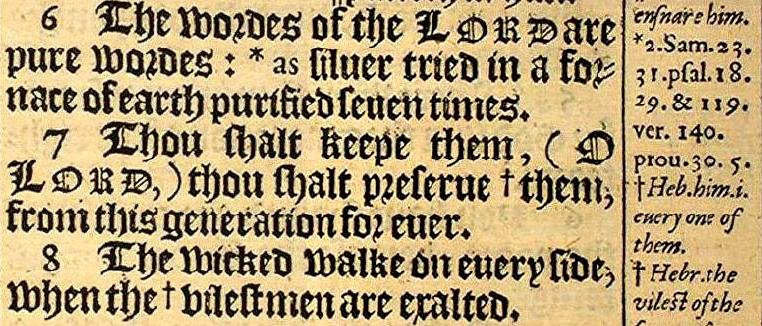
 = "purified
seven" Note that "u" was often substituted for "v".
= "purified
seven" Note that "u" was often substituted for "v".